For Registration, enquiry contact us 80720 20716

Unlocking the Language of Medicine: A Deep Dive into Procedures and Anatomy
Medical terminology often feels like a foreign language, filled with complex prefixes, suffixes, and anatomical references that can be daunting for patients and students alike. However, understanding these terms is essential for navigating everything from operative reports to diagnostic coding. Using insights from medical exam materials and clinical case studies, let’s break down the key components of medical language.
MEDICAL CODING TRAINING
Medical Coding Officers Academy
4/7/20262 min read
The Anatomy of Anatomy
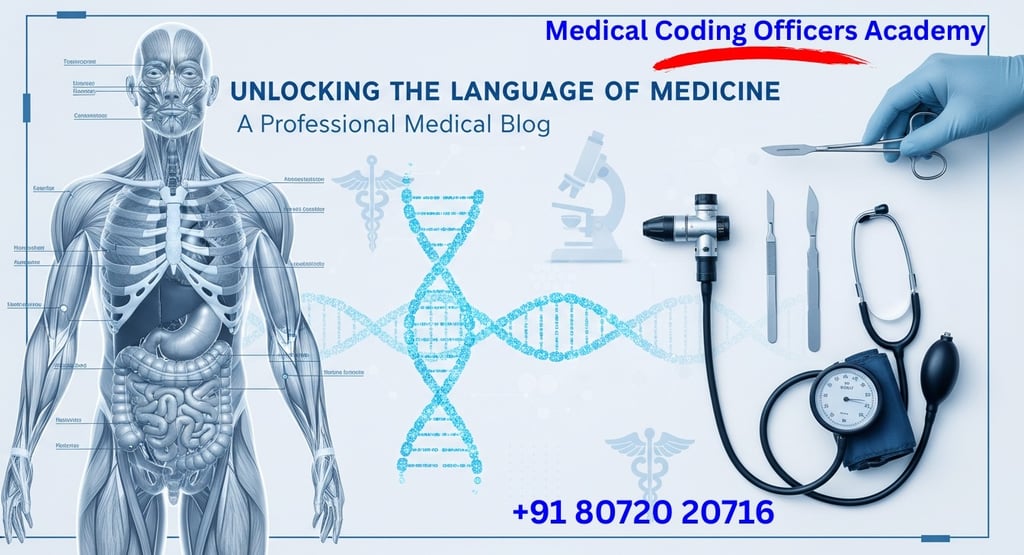
Medical professionals use precise terms to describe every corner of the human body. For instance, did you know that the clavicle is the medical term for your collarbone, or that the patella is your kneecap?. Other essential anatomical landmarks include:
The Digestive System: The duodenum is the very first portion of the small intestine.
The Sensory Organs: Behind your cornea lies the anterior chamber of the eye. Meanwhile, the inner ear is composed of intricate structures like the vestibule, malleus, incus, and stapes.
Combining Forms: Many medical words are built from "combining forms." For example, the form "dips/o" specifically refers to thirst.
Decoding Surgical Procedures
When a surgeon performs a procedure, the name of that procedure usually tells you exactly what happened. A common suffix is "-ectomy," which means surgical removal.
Salpingectomy: The surgical removal of a fallopian tube.
Hysterectomy: The surgical removal of the uterus.
Pancreatectomy: The total removal of the pancreas, often performed if malignant cells are found during a biopsy.
Other procedures focus on repair or exploration. An endoscopy, such as a proctosigmoidoscopy, involves using a camera to examine the rectum and sigmoid colon. In emergency orthopedics, a compound humerus fracture might require an ORIF (Open Reduction Internal Fixation), where the bone is set using a 6-hole plate and cortical screws.
Understanding Tissue Grafts
In reconstructive surgery, surgeons often use grafts to repair damaged areas. The source of that tissue determines its name:
Autograft: Tissue taken from one part of a patient's body and moved to another. An example is taking split-thickness skin grafts from a patient's thighs to repair an open wound on the same patient.
Allograft (Homograft): Tissue taken from a donor of the same species.
Xenograft: Tissue taken from a different species.
The Role of Medical Coding
Behind every procedure is a system of codes used for billing and tracking. Professionals use the CPT (Current Procedural Terminology) manual to find specific codes for services, using hyphens to indicate a range of codes in the index. They also use modifiers, such as "T5," which specifically indicates the great toe of the right foot. This level of precision ensures that medical records are accurate and that healthcare providers are reimbursed correctly for the complex work they perform.
Whether you are looking at a lumbar puncture (a spinal tap) or a craniotomy (opening the skull to access the brain), understanding these terms provides a clearer window into the world of healthcare. By mastering the "building blocks" of medical language, we can better understand the care we receive and the incredible complexity of the human body.
Quick links
Contact Us
+91 - 80720 20716
medicalcodingofficers@gmail.com
All Rights Reserved. Website Design by Medical Coding Officers Academy
Medical Coding Officers Academy
India's top most training center for medical coding, billing and RCM in healthcare industry.
Subscribe to our newsletter
70/1, 2nd Floor, 200 Feet Radial Road, Pallavaram to Thuraipakkam Road, Near A2B Restaurant, Pallikaranai, Chennai, Tamil Nadu 600100