For Registration, enquiry contact us 80720 20716

ICD-11: Features, Benefits, and Everything Medical Coders Need to Know
The healthcare industry continuously evolves with advancements in medicine, technology, and disease management. To keep pace with these changes, the World Health Organization (WHO) introduced the International Classification of Diseases, 11th Revision (ICD-11) as the latest global standard for reporting diseases, health conditions, injuries, and causes of death.
ICD-11
Dr.Jeevanantham Mariappan, Founde & CEO of Medical Coding Officers Academy
6/9/20264 min read
ICD-11: Features, Benefits, and Everything Medical Coders Need to Know
Introduction
The healthcare industry continuously evolves with advancements in medicine, technology, and disease management. To keep pace with these changes, the World Health Organization (WHO) introduced the International Classification of Diseases, 11th Revision (ICD-11) as the latest global standard for reporting diseases, health conditions, injuries, and causes of death.
ICD-11 represents the most significant transformation in disease classification since ICD-10. It is designed for the digital era, offering improved accuracy, interoperability, and flexibility for healthcare providers, researchers, policymakers, and medical coders worldwide. (World Health Organization)
What is ICD-11?
ICD-11 is the 11th revision of the International Classification of Diseases developed by the World Health Organization. It serves as a global standard for:
Disease classification
Clinical documentation
Mortality reporting
Morbidity reporting
Health statistics
Public health surveillance
Reimbursement systems
Research and epidemiology
ICD-11 was officially adopted by the World Health Assembly in 2019 and came into effect globally on January 1, 2022. (WHO Test CMS)
Why Was ICD-11 Developed?
ICD-10 served healthcare systems for decades but had several limitations:
Limited digital capabilities
Inability to fully capture modern clinical concepts
Lack of interoperability with electronic health records
Insufficient coding specificity for many diseases
Growing need for advanced healthcare analytics
ICD-11 addresses these challenges through a modern, digital-first design. (World Health Organization)
Key Features of ICD-11
1. Fully Digital Architecture
Unlike ICD-10, ICD-11 was built specifically for digital healthcare environments.
Benefits:
Online and offline access
Integration with Electronic Health Records (EHRs)
API-based connectivity
Automated coding support
Faster clinical documentation
This digital-first approach significantly improves coding efficiency and reduces manual errors. (WHO Test CMS)
2. Expanded Clinical Content
ICD-11 contains:
Approximately 17,000 diagnostic categories
More than 120,000 codable terms
Over 130,000 clinical concepts
More than 1.6 million searchable terms through coding combinations
This allows much more precise representation of patient conditions. (World Health Organization)
3. Smart Coding and Search Functionality
ICD-11 includes advanced coding tools that:
Suggest appropriate codes
Interpret clinical terminology
Support natural language processing (NLP)
Reduce coding errors
Healthcare professionals can find codes faster than with traditional manual coding methods. (World Health Organization)
4. Post-Coordination and Extension Codes
One of the most innovative features of ICD-11 is post-coordination.
Instead of assigning multiple separate codes, coders can combine codes to capture:
Severity
Anatomical location
Histopathology
Causative agents
Complications
Medical devices
Medications
This provides unprecedented clinical detail while maintaining flexibility. (World Health Organization)
5. Improved Interoperability
ICD-11 integrates seamlessly with:
Electronic Health Records (EHRs)
Health Information Systems (HIS)
International healthcare terminologies
FHIR-based digital health systems
This supports better data sharing across healthcare organizations globally. (World Health Organization)
6. Multilingual Support
ICD-11 is designed for global use and supports multiple languages.
Recent updates have expanded availability to 14 languages, helping improve accessibility and adoption worldwide. (World Health Organization)
New Chapters Introduced in ICD-11
Several new chapters were added to reflect advances in medicine.
Examples include:
Diseases of the Immune System
Provides better classification of autoimmune and immune-related disorders.
Sleep-Wake Disorders
Introduces modern classification of sleep disorders.
Conditions Related to Sexual Health
Offers a more scientifically accurate framework for sexual health conditions.
Traditional Medicine
For the first time, ICD-11 includes coding for traditional medicine diagnoses and services, including systems such as Ayurveda, Siddha, and Unani. (World Health Organization)
Major Improvements Over ICD-10
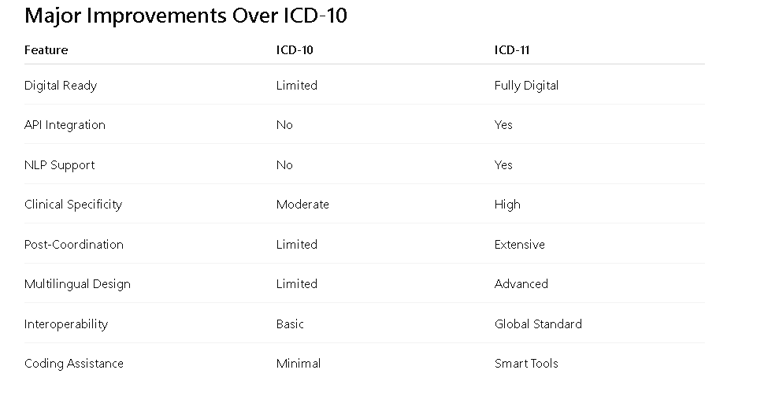
FeatureICD-10ICD-11Digital ReadyLimitedFully DigitalAPI IntegrationNoYesNLP SupportNoYesClinical SpecificityModerateHighPost-CoordinationLimitedExtensiveMultilingual DesignLimitedAdvancedInteroperabilityBasicGlobal StandardCoding AssistanceMinimalSmart Tools
Benefits of ICD-11 for Medical Coders
Improved Coding Accuracy
Enhanced clinical detail reduces ambiguity and improves coding precision. (World Health Organization)
Faster Coding Workflow
Smart search tools and automated suggestions decrease coding time. (World Health Organization)
Better Career Opportunities
As healthcare systems transition toward ICD-11, coders with ICD-11 knowledge will become increasingly valuable.
Reduced Training Burden
WHO reports that ICD-11 requires less training compared to previous revisions because of its intuitive digital design. (World Health Organization)
ICD-11 and Artificial Intelligence
ICD-11 is designed to support future healthcare technologies including:
Artificial Intelligence
Machine Learning
Clinical Decision Support Systems
Automated Coding Systems
Predictive Analytics
The 2025 update introduced advanced NLP capabilities and enhanced API integration, making ICD-11 particularly suitable for AI-powered healthcare environments. (World Health Organization)
Challenges in ICD-11 Implementation
Despite its advantages, organizations may face:
Training Requirements
Staff must learn new coding structures and workflows.
Software Upgrades
Healthcare systems require updates to support ICD-11.
Mapping from ICD-10
Crosswalks and conversion strategies are necessary for data continuity.
Resource Allocation
Implementation may require investment in technology and workforce development. (World Health Organization)
Future of ICD-11
WHO continues to update ICD-11 annually, ensuring it remains aligned with evolving medical science and healthcare practices. The classification is expected to become the foundation for:
Global health reporting
Digital health transformation
AI-assisted coding
Population health management
International healthcare interoperability
Countries around the world are actively preparing for or implementing ICD-11 as part of their healthcare modernization efforts. (World Health Organization)
Conclusion
ICD-11 is much more than a coding update—it is a comprehensive digital health platform designed for the future of healthcare. With enhanced specificity, smart coding tools, interoperability, AI readiness, and improved clinical representation, ICD-11 is set to revolutionize medical coding and health information management worldwide.
For medical coders, healthcare organizations, and health information professionals, understanding ICD-11 is no longer optional—it is becoming an essential skill for the next generation of healthcare documentation and analytics.
Medical Coding Officers Academy encourages all aspiring and experienced medical coders to start learning ICD-11 concepts today to stay ahead in the rapidly evolving healthcare industry.


Quick links
Contact Us
+91 - 80720 20716
medicalcodingofficers@gmail.com
All Rights Reserved. Website Design by Medical Coding Officers Academy
Medical Coding Officers Academy
India's top most training center for medical coding, billing and RCM in healthcare industry.
Subscribe to our newsletter
70/1, 2nd Floor, 200 Feet Radial Road, Pallavaram to Thuraipakkam Road, Near A2B Restaurant, Pallikaranai, Chennai, Tamil Nadu 600100